
WellTechAI - Muhammad Abid
It Was a Tuesday Morning
Two days earlier she had developed redness and itching where her nicotine patch was sitting on her skin. She panicked. She had no one to ask that she trusted. So she took the patch off.
Within two days she started smoking again.
She called me five days later. I told her in less than a minute what she needed to know. It was a completely normal reaction. She just needed to move the patch to a different spot on her body. Something I had actually told her in her very first session that she had forgotten in the panic of the moment.
She followed the advice. She quit.
But she had spent five unnecessary days smoking because she could not get a simple trusted answer at the moment she needed it.
She was not unusual. She was not weak. She was a working mother in one of the most deprived wards in Luton, juggling three children, a part time job, and one of the hardest behavioural changes a human being can make. And the system had left her completely alone at the moment she needed it most.
I sat with that for a long time.
The Gap I Could Not Stop Seeing
That phone call was not unusual. That is what made it impossible to ignore.
Over almost three years of delivering NHS linked stop smoking services in Bedfordshire I watched the same thing happen in dozens of different ways. Clients who relapsed over the weekend because something happened on a Saturday evening and there was nobody there. Clients who lost momentum after one missed appointment and by the time anyone followed up were already back where they started. Clients who did not call when things went wrong because they did not want to bother anyone.
Many of the people I worked with came from Luton's most diverse and underserved communities. South Asian families where smoking was deeply embedded in social and cultural life. Eastern European workers with limited English who struggled to navigate NHS services. People in areas of high deprivation where stress, unemployment, and poor housing made quitting exponentially harder. People who had been let down by services before and came to me already half expecting to be let down again.
And underneath all of it was a language barrier that nobody was properly solving. A client who speaks Urdu as their first language and is embarrassed to ask a question in English will not call their stop smoking advisor when they are struggling at 11pm. They will just light a cigarette instead.
Every single time the support they needed was simple. A reassurance. A reminder. Thirty seconds of trusted guidance in a language that felt safe. That would have made all the difference.
People will say they could have Googled it. But Google is informative. It is not reassuring. When you are scared and fighting one of the hardest battles of your life you do not want search results. You want someone you trust to tell you it is going to be okay. In your language. At your level. Without judgement.
At some point I stopped just watching and started building.
The Decision Nobody in My Position Is Supposed to Make
I am not a traditional software engineer in the way most people mean that phrase. But I am also not a complete outsider to technology.
I studied Software Engineering at university years ago. But my career took me into public health instead. Stop smoking services. NHS Health Checks. Community health programmes. The human side of behaviour change rather than the technical side of building systems.
When I decided to build WellTechAI I was relearning things I had forgotten and learning entirely new things at the same time. That was uncomfortable. There were nights where I genuinely did not know if what I was building would work. There were moments of complete imposter syndrome where I wondered who I thought I was trying to build an AI healthcare platform alone.
But I had one thing that most engineers building health technology do not have. I had almost three years of sitting with real people in real crisis. Not user personas. Not focus groups. Real people from real communities telling me in their own words what they needed, what scared them, what made them trust a service and what made them walk away from one.
That knowledge turned out to be worth more than I expected.
The sensible thing would have been to write a report. Wait for someone more qualified to come along and build it. But I had watched too many people fall through too many gaps. And I knew that the people best positioned to fix a problem in healthcare are almost never the ones who end up fixing it. They hand the insight to someone else who does not fully understand it and the result is technology that looks good in a boardroom and falls apart in real life.
Specifically it falls apart for the communities who need it most. The ones who do not fit the assumed user. The ones who speak English as a second language. The ones who are not comfortable with apps and digital platforms. The ones who the NHS already struggles to reach.
I did not want to hand this to someone else.
What Makes WellTechAI Different
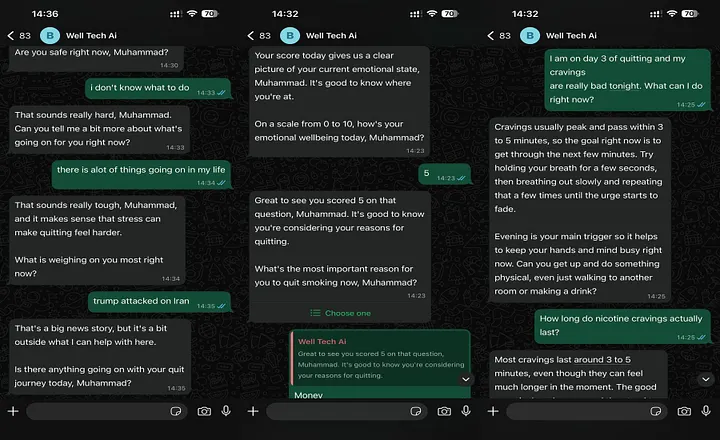
There are other AI chatbots in health. There are other stop smoking apps. What makes WellTechAI different is not the technology. It is the three years of frontline knowledge embedded into every decision the technology makes.
Most health AI is built by engineers who have never sat with a patient. It answers the questions users type. WellTechAI answers the questions users are actually asking underneath the words they type. The fear. The shame. The uncertainty. The need to feel like someone is there.
That distinction comes entirely from time spent in a room with real people going through something hard. You cannot build it from a dataset. You cannot hire it. You have to have lived it.
Here are the three technical decisions that reflect that human knowledge most directly.
RAG Over a Simple Chatbot
Language models can sound confident while being wrong. In healthcare that is dangerous. In healthcare serving communities with lower health literacy and higher vulnerability it is even more dangerous. RAG stands for Retrieval Augmented Generation. It means the AI searches a curated knowledge base of verified NHS stop smoking clinical guidance before it responds rather than generating from general training alone.
In plain language I gave the AI a textbook to check before it spoke. Every response is grounded in verified clinical information. Accuracy is not optional when you are dealing with someone's health.
Delivered Through WhatsApp in Any Language
Because that is what my clients actually used every day without thinking about it. Not an app they would need to download. Not a website they would need to remember to visit. Not a platform that assumes a certain level of digital confidence. WhatsApp. Already on their phone. Already opened dozens of times a day. Already trusted across every community I worked with regardless of age, background, or digital literacy.
And because the AI understands and responds in dozens of languages automatically it meets people not just where they are physically but where they are linguistically and culturally. Someone messages in Urdu and the AI responds in Urdu. Someone writes in Bengali and the AI responds in Bengali. Arabic. Polish. Romanian. Hindi. Punjabi. The clinical guidance is the same. The language is theirs.
In Luton where significant communities speak Urdu, Bengali, Arabic, Polish, and Romanian as their first language this is not a feature. It is a fundamental act of inclusion that no traditional stop smoking service has ever been able to offer at scale.
A client who is embarrassed to ask a question in English at 11pm will not call their advisor. They will light a cigarette instead. WellTechAI removes that barrier entirely.
Meeting people where they already are is one of the most fundamental principles in public health. That means their platform. Their language. Their culture. All at once.
Human Escalation Logic Built Into the Core
The AI knows what it is good at and what it is not. When a conversation goes beyond what it should handle it steps back, acknowledges the person warmly, and connects them immediately to a real human being. AI should never be the final word on whether someone is in crisis. Particularly not when that someone is already vulnerable and already fighting to trust a system that has let them down before.
The full stack runs on TypeScript, AWS Lambda, DynamoDB, and Claude AI. I built the web platform myself as well.
What Eight Weeks Actually Looked Like
I want to be honest about this because the headline sounds impressive and the reality was considerably more human than that.
The first two weeks were almost entirely reading, planning, and setting up. AWS accounts, architecture decisions, TypeScript configuration, understanding the Meta WhatsApp Business API documentation which is extensive and occasionally baffling. Very little visible progress. A lot of foundation work.
Weeks three and four were backend development. Lambda functions, API endpoints, database schema design. I rebuilt the database schema twice because I got the structure wrong the first time. That is normal and I am glad I caught it early.
Weeks five and six were the AI integration. Connecting to Claude AI, building the RAG pipeline, populating the knowledge base with accurate stop smoking guidance, testing the responses obsessively. I must have had over two hundred test conversations with the AI myself before I let anyone else near it. Including testing in Urdu, Bengali, and Arabic to make sure the clinical accuracy held across languages not just in English.
Week seven was the WhatsApp integration working end to end. The first time a test message went through WhatsApp and came back with a clinically accurate AI response I sat quietly for a moment. It worked.
Week eight was testing, fixing, and more testing. I found eleven things that were broken or incomplete. I fixed nine of them before launch. The other two became the first priorities for version two.
I will not pretend it was smooth. There were evenings where I had no idea what I was doing. There were bugs I could not find for hours that turned out to be one missing character in a configuration file. There was imposter syndrome at 11pm wondering who I thought I was trying to build something that mattered.
But I had something that kept me going through every one of those moments. I knew exactly who I was building for. I could close my eyes and see her. The working mother in Luton who waited five days to ask a thirty second question. The five days that did not have to happen.
That clarity is worth more than any amount of technical confidence.
What This Experience Taught Me
Three things that I believe matter and that I do not see discussed enough.
Domain Knowledge Is Not Optional
You can hire engineers to build healthcare AI. You cannot hire three years of sitting with patients from communities the NHS already struggles to reach. You cannot shortcut the experience of watching dozens of people fall through dozens of gaps and understanding at a cellular level what they needed in each of those moments. The technical build was eight weeks. The knowledge behind it was three years.
Safety Is a Design Principle Not a Feature
Human escalation logic. RAG grounding. GDPR compliant data infrastructure. Audit trails. These things were designed into the architecture from day one because retrofitting them later is expensive, dangerous, and often incomplete. If you are building AI for healthcare and you are thinking about safety as a final step before launch you are thinking about it wrong.
The Person Always Comes First
Not the technology. Not the business model. Not the demo. The person fighting a craving at 11pm on a Saturday. The person who got a skin reaction and did not know what to do and waited five days to call because they did not want to be a bother. The person whose first language is not English and who needs the response to be warm and clear and in a language that feels safe. If a technical decision does not make their experience better it is the wrong decision regardless of how elegant it is.
Where This Goes Next
WellTechAI is live and pilot ready. I am currently working to establish formal pilot partnerships with stop smoking services across the UK through Health Innovation East and DigitalHealth.London.
The multilingual capability means this is not just a tool for English speaking communities. It is a tool for every community. And in a country as diverse as the UK where health inequalities are deepest in the communities that existing digital health tools most consistently fail to reach that matters enormously.
And this is bigger than smoking cessation. Weight management. Addiction recovery. Mental health. Every area where people are trying to make difficult changes and finding themselves alone in the moments that matter most. The gap is the same everywhere. It is deepest in the communities that are already most underserved.
WellTechAI is a Community Interest Company. Any surplus goes back into the mission. The communities I spent three years serving deserve technology built in their interest. Not technology built about them by people who have never met them.
If you have spent years working inside a problem and you can see what technology could do but nobody is doing it, and you are wondering whether you have enough to try, the honest answer is probably yes.
The knowledge you already have is worth more than you think. Especially if that knowledge was built in rooms that most tech founders have never entered.
Start building.
Muhammad Abid is the Founder of WellTechAI CIC and a Public Health professional with an MSc in Public Health and a BSc in Software Engineering. He spent almost three years delivering NHS linked stop smoking services in Bedfordshire, working with some of the UK's most diverse and underserved communities, before building a live multilingual AI platform from scratch as the sole engineer. He builds at the intersection of clinical domain knowledge and hands on AI engineering, with a specific focus on reaching communities that digital health most often leaves behind. welltechai.co.uk